Raliera


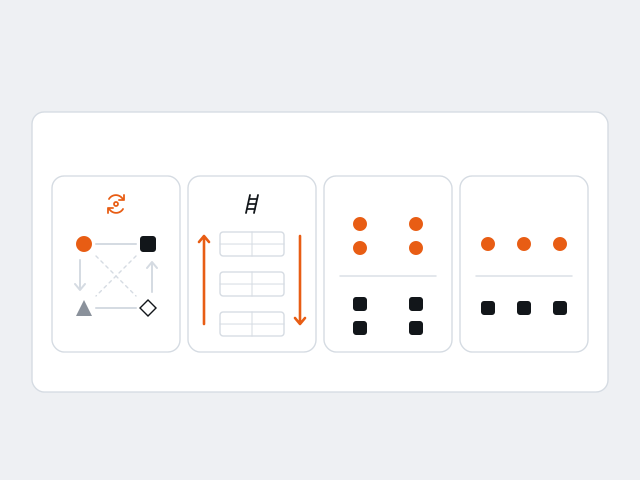
For owners, program directors and league coordinators choosing a weekly league. ERA Pickleball runs all four formats below on the same courts, each on a different kind of night.
Start with what your players want from the night
Before you pick a format, ask what the people who already come on a weeknight are looking for. Almost every answer falls into one of three:
- A social night. They want to meet people, play with different partners and go home having played as much as everyone else. That is a round robin.
- A fair ranking. They want to know who is best, and they want the night to sort them by level. That is a ladder.
- A team. They want a captain, a rival and a reason to come back next week for the others. That is an MLP-style team league or 3v3.
Most clubs end up running more than one, on different nights, because the people who want each one are different people.
Round robin leagues
In a round robin, every player or pair meets a set list of partners or opponents over the night. There are two common versions:
- Rotating partners. Players sign up alone and get a new partner every round. Nobody needs to find a partner to join, which is why this is the easiest league to fill.
- Fixed partners. A pair signs up together and plays the other pairs. It suits players who already have a regular partner.
Round robins suit social leagues and mixed levels, because nobody gets stuck on the bottom court all night. Standings usually rank by games won, then point differential.
The hard part is the arithmetic. Numbers that don’t divide by four leave byes, and one late arrival can break a schedule that was built for an even count. The fix is to build the night from the players who actually checked in, not the roster, and to decide in advance what a bye scores.
Ladder leagues
A ladder moves players by results, so by the end of a few rounds the strongest players are playing each other. ERA runs two kinds.
Court ladder
Courts are ranked from top to bottom. After each round, winners move up a court. You choose two things before the season starts:
- Partners. Either players rotate partners every round, or each player keeps one partner for the night.
- Movement. Either winners move up and losers stay, or winners move up and losers move down. When losers stay, the losers on the top court start again on the bottom court, so the ladder keeps turning.
Pod ladder
Players are split into pods, and everyone in a pod plays everyone else in it. With 16 players in four pods of four, each pod plays three games. Then the pods are rebuilt by where players finished: all the first places together, all the seconds together, and so on. Two sets make six games.
Pods of five work too. Twenty players make four pods of five, with one player sitting out each game, and each set is four games played.
Ladders suit players who want a ranking that means something by the end of the season.
MLP-style team leagues
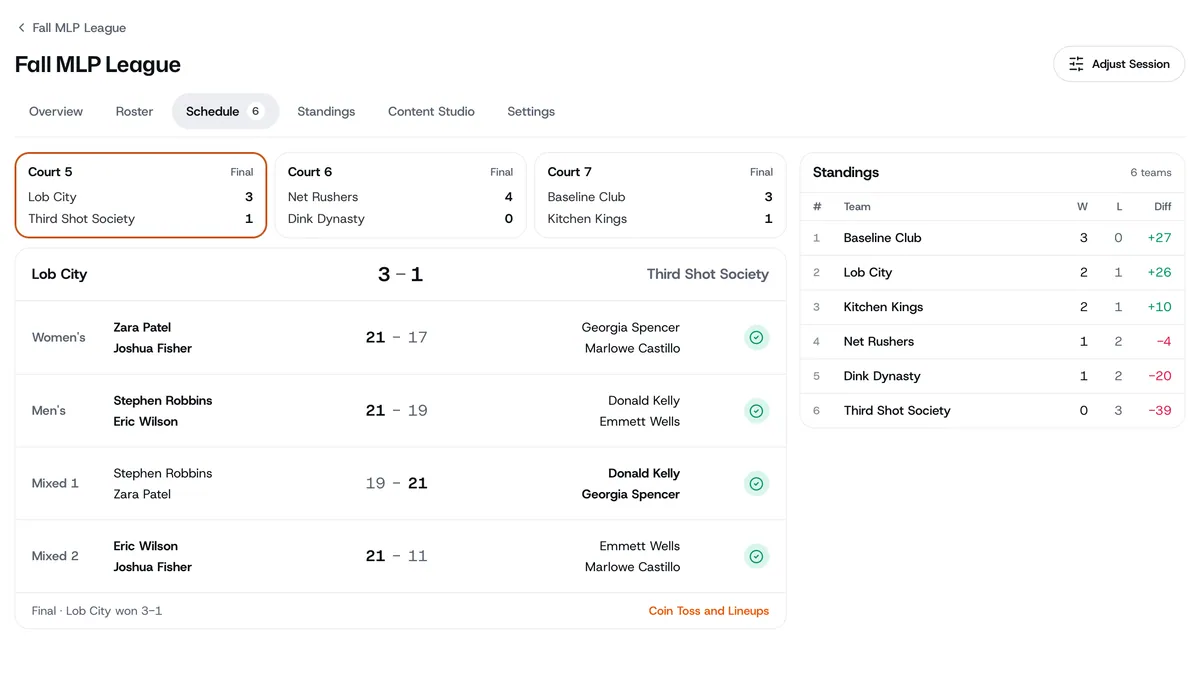
An MLP-style league turns pickleball into a team sport. Two teams of four, two men and two women, meet in a match of doubles games. The classic format is a women’s game, a men’s game and two mixed games. ERA’s Tuesday league plays four mixed games instead of two, so a match is six games, each one game with rally scoring to 21. Every game is played. If the teams split the games evenly, a DreamBreaker decides the match.
The order of play is set before the first serve:
- The coin toss. The winner’s first choice is home or away.
- Side and serve. The away team picks side or serve, and the home team gets the other.
- Lineups, in turns. The away team sets its pairs for two games first, the home team answers, then they swap. A player can’t play with the same partner twice, so everyone partners every teammate during the night.
ERA runs three versions:
- Traditional. Teams stay together all season.
- Draft. Captains pick their teams before the season starts.
- Beginner. Staff make new teams of four every session from the players who checked in, balanced by league results and then by DUPR, with no repeat teammates where it can be avoided. Each team plays one opponent a session, everyone plays three games, and players are ranked on their own rather than by team. It is built to bring newer players into league play.
3v3 leagues
In 3v3, teams of three sign up together. Every pair on one team plays the matching pair on the other: A and B, then B and C, then A and C. Each player plays two games against each opponent, with a different teammate each time.
A league picks one of two nights:
- One opponent. Each pair plays best of three games.
- Two opponents. Each pair plays one game to 11, win by 2, against each team, which is six games a night.
Teams can be men’s, women’s or mixed, where mixed means two of one and one of the other. Captains set who is A, B and C before each matchup, and a coin toss decides which team sets its lineup first and who picks serve and side.
3v3 suits a group of three friends who want a team without finding a fourth, and it is easier to field than a team of four because one absence still leaves a pair.
How standings work in each format
Standings decide whether players trust the league. Publish the order before week one, show it on the standings page, and never change it mid-season.
| Format | Ranks first by | Then |
|---|---|---|
| Round robin | Games won | Point differential |
| Ladder | Wins or court finish across the season, set before week one | Point differential |
| MLP-style team league | Matchup win percentage, DreamBreakers included | Head to head (only if every tied team played each other), point differential, game win percentage |
| MLP Beginner | Each player on their own | Games and points |
| 3v3 | Matchups won | Pair games won, then points |
The head-to-head rule in the MLP league is worth copying. In a three-way tie where the teams haven’t all played each other, head to head would decide the order on one result and ignore the rest, so it only applies when every tied team has met.
What each format asks of your front desk
The format you choose decides how much work the desk does on the night. A rough guide from ERA’s nights:
- Round robin: check players in, build the rounds from who arrived, and enter scores. The most players for the least setup.
- Ladder: the same, plus moving players after every round or set. Scores have to come in quickly, because the next round depends on them.
- MLP-style: check teams in, run the coin toss and lineups, and enter six games and a DreamBreaker per match. The most work per court, and the most atmosphere.
- 3v3: captains set lineups, and pairs report their own games. Fewer players per court than a team of four.
Whichever format you choose, decide before the season who enters scores (the desk, captains or players), what happens when a player doesn’t show, and how a sub is added. Those three questions cause more league-night arguments than the format itself.
ERA Pickleball’s league formats
| Format | Players sign up | A night | Suits |
|---|---|---|---|
| Round robin | Alone, or as a pair | A new partner or opponent every round | A social night at mixed levels |
| Court ladder | Alone | Winners move up a court each round | Players who want to climb |
| Pod ladder | Alone | Pods of four or five, re-podded by finish | A fair ranking without one bad court |
| MLP Traditional and Draft | As a team of four, or drafted by captains | Six games to 21 and a DreamBreaker if 3 to 3 | Players who want a team for the season |
| MLP Beginner | Alone | New teams every session, three games each | Newer players trying league play |
| 3v3 | As a team of three | Every pairing, one or two opponents | Three friends who want a team |
Choosing a format for your players
Start with the players you already have on a weeknight, not the league you wish you had.
A mixed-level crowd that comes to meet people fits a rotating round robin. A group that asks every week who the best player on the court is fits a ladder. Players who want a team, a captain and a rival fit an MLP-style league or 3v3, and if they are newer to league play, a version where staff make the teams each session gets them in without the pressure of picking a team.
Run one format well before you add a second. A league night that starts on time, finishes on time and posts standings the same night will fill again next season, whatever its format.